Never 2 Late 2 Learn (The Lingo)
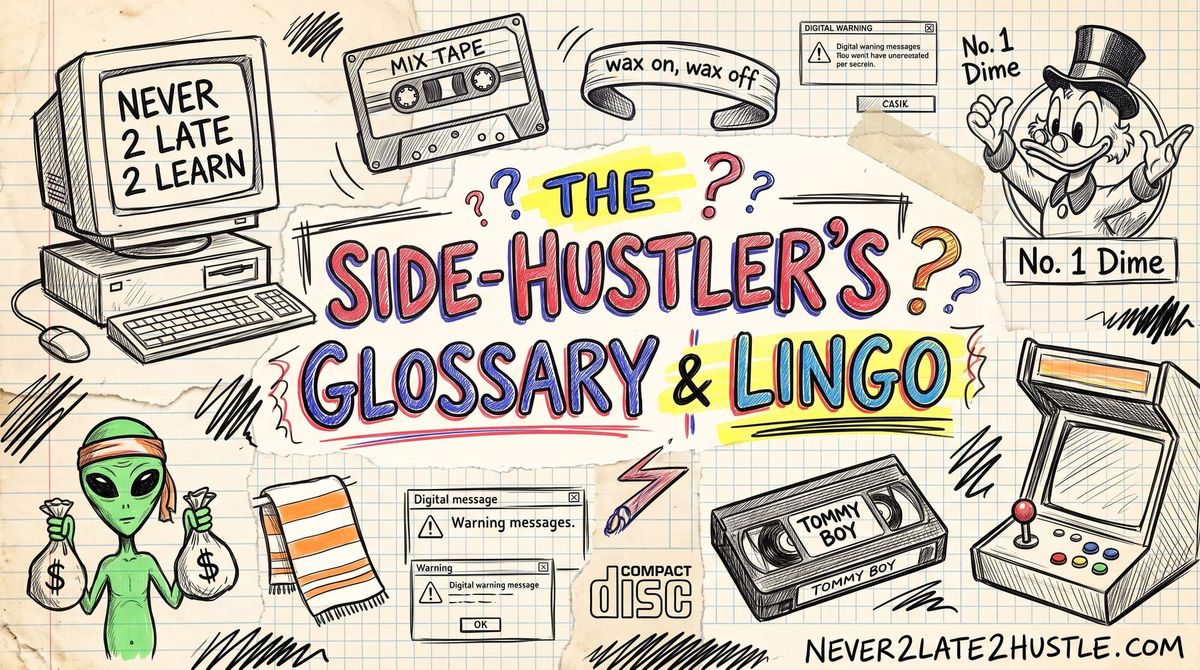
The Side-Hustler's Glossary & Lingo: A plain-English breakdown of micro-task terms, survey acronyms, investing basics, and Gen X pop culture references across Prolific, CloudResearch Connect, Clickworker, UserTesting, and more
Platform Basics
Assigned Jobs – Tasks that Clickworker has specifically matched to your profile and qualifications. These are yours until they expire or you complete them.
Available Jobs – The open marketplace on Clickworker. First come, first served. The good ones go fast, but the bad ones stick around a while.
Instant Jobs – Shorter, simpler tasks that can be grabbed and completed quickly; usually lower pay, but less time commitment.
Computer Jobs – Tasks on Clickworker that require a desktop or laptop rather than the app on your phone.
Partner Jobs – Third-party tasks and games that flow through Clickworker from outside providers.
UHRS – Universal Human Relevance System (often called Ultra Human Relevance Scale). A micro-task system that runs through Clickworker (similar to Amazon's Mechanical Turk, which is no more). Looks attractive, but apparently there's not much work here and the general consensus on Reddit is that it has faded significantly. (See Is UHRS still worth doing on Clickworker? in the FAQ.)
Record Count – The number of individual items in a task. High record count is not automatically good, so do the math before you commit.
Study – What Prolific and CloudResearch Connect call their tasks. Usually more "academic" (i.e., from universities) than Clickworker's "jobs."
Submission – Your completed response to a study on Prolific or Connect. Gets reviewed and approved before payment releases.
The Money Stuff
1099 (1099-NEC / 1099-K) – The IRS tax form that reminds you the government wants its cut of your side hustle. Because platforms like Prolific, Connect, Clickworker, and UserTesting treat you as an independent contractor rather than an employee, no taxes are withheld from your payouts. You’ll typically see a "1099-NEC" if a platform pays you $600+ directly, or a "1099-K" from PayPal if your combined payouts cross the IRS reporting threshold. Be aware: thinking that if you earn under $600 on a site and don’t get a form in the mail, the money is "tax-free." It isn't – you still have to report every dollar on your taxes so it's not a bad idea to set a slice aside before you invest the rest.
Approval – On Prolific and Connect, completed submissions go through a review process before payment is released. Usually fast, occasionally not. (See why funds sit in Awaiting Review on Prolific or Pending on Connect.)
DQ (Disqualification) – Getting screened out of a survey before it starts, or occasionally partway through. The screener questions at the beginning exist to filter for a specific demographic. If you're not their person, you're out. Clickworker typically pays $0.02 for a DQ. Annoying, but better than nothing. (Read the math on why high-paying Prolific studies screen you out most.)
Payout Threshold – The minimum balance you need to reach before a platform will pay you. On Clickworker it's $10, on Prolific it's £6/$6, on Connect it's $5, and on UserTesting it's $1 (paid automatically after 14 days). Know the threshold on every platform you use.
Reward Reversal – Money that was credited to your account and then taken back, sometimes weeks later. Shows up as a negative on your invoice. Happens when a provider flags a quality issue or identifies a technical problem. Read your invoices, and check out the FAQ breakdown on Reward Reversals vs. Storno.
Schedule C (Form 1040) – Officially titled Profit or Loss From Business, this is the attachment to your personal tax return where your side hustle becomes an actual business on paper. As a single-member LLC, Schedule C is where you tally up all your gross side hustle payouts (from your 1099s) and subtract your legitimate "ordinary and necessary" business expenses – like a dedicated webcam, software, LLC state fees, or a slice of your internet bill. Why you should love it: you only pay taxes on your net profit (what’s left after deductions) not your total payouts and that final profit line is what officially unlocks your ability to funnel side-hustle cash into self-employed retirement accounts.
Storno – A specific type of reversal on Clickworker where your payment is pulled, relabeled "Storno," and reissued under a corrected amount. Net financial impact is often zero, but it means your work was reviewed and adjusted. Quality matters. (Full explanation in Don't Panic: The Side Hustle FAQ.)
Weekly Payout – Clickworker pays once a week as long as you've hit the threshold. Prolific and Connect release payment after study approval, which can vary.
The Survey World
BitLabs – Survey provider. Consistency is key here — conflicting profile information across sessions can get you permanently banned. Ask me how I know.
Consistency – Not a platform term, but the single most important word in this whole glossary. Pick your profile information, pick your industry, pick your income range — and never change it. Inconsistency gets accounts flagged and banned across Prolific, Connect, and Clickworker.
CPX Research – One of the more common survey providers you'll encounter on Clickworker. Reliable, but variable DQ rates.
DQ Rate – How often you're getting disqualified from surveys. A high DQ rate isn't always your fault – it often just means your demographic isn't what clients are looking for right now. Move on quickly.
Human-in-the-Loop (HITL) – A model of artificial intelligence development and execution where human operators step in to train, tune, validate, or correct AI outputs. In the side hustle ecosystem, this is what you're actually doing on Connect, Prolific, and Clickworker when you rate AI audio, evaluate dialog, or check relevance scales – you're the quality control layer keeping the algorithms honest.
inBrain – Another survey provider that flows through Clickworker. Similar experience to CPX.
Prime Opinion / Torox / Ayet / PureSpectrum – Other providers you'll encounter in the survey router ecosystem. Each has its own payout logic and quality of experience. You'll develop opinions over time.
Screener Questions – The questions at the start of a survey designed to determine if you match the target demographic. Answer honestly. Always.
Survey Router – A system that pulls surveys from multiple providers and serves them through one interface. On Clickworker you are often going through a router without knowing it – CPX, inBrain, TapResearch, Ayet, and others all flow through. (See how to avoid Survey Router bans.)
TapResearch – Survey provider in the Clickworker ecosystem. Part of the router network.
The Platforms
(Want the side-by-side comparison first? Start with The Platforms: Four Side Hustle Platforms, Compared Honestly.)
Clickworker – Founded 2005, headquartered in Germany, recently acquired by LXT AI out of Canada. A platform where companies and researchers post small digital tasks for completion. Covers surveys, voice tasks, data collection, secret shopper, games, and more. Pays weekly. The site: clickworker.com. And my take.
Connect by CloudResearch (aka "CRC") – Research platform with a strong academic and corporate client base (including high-paying Jury Research studies). No waiting room once you're in. Solid and consistent once you learn the dashboard. The site: cloudresearch.com. And my take.
Prolific – Academic research platform widely considered the gold standard for survey and study work. Requires an application and approval process that can take days to weeks. Worth the wait. The site: prolific.com. And my take.
UserTesting – Platform where you test websites, apps, and products and record your reactions and feedback. Different format from survey work – more narrative, more time per task ($10 for 5–10 minute screen-plus-voice tests), different skill set. The site: usertesting.com. And my take.
Voice and Audio Tasks
AI Audio Comparison – Side-by-side evaluation of two AI audio outputs. Fast when the clips are short. Know the difference before you commit. (Featured heavily in my summer update, Summertime, and the hustlin's easy.)
Dialog Evaluation – Tasks involving rating AI-generated conversations for naturalness, coherence, and quality.
Time Transparency – Clickworker's ongoing weak spot. Not all tasks clearly show how long they will take before you accept them. Preview the task, count the records, estimate the time, do the math.
Voice Naturalness – A specific type of voice evaluation task rating how human or natural an AI voice sounds.
Voice Preference Task – A task where you listen to two AI-generated voice samples and indicate which sounds more natural, more appealing, or better fits a given use case. Among the best-paying tasks on Clickworker on a per-hour basis, and the hero of my Q3 Summer Results.
The Investing Side
(Quick disclaimer: None of this is financial advice or fund-picking – just the plain-English mechanics and structure behind where my side-hustle money goes.)
401k – Employer-sponsored retirement account. Usually pre-tax contributions, tax-deferred growth. The third leg of the investment stool, introduced in Paging My Inner Gekko.
Broad-Market Index Fund – A fund designed to track the performance of an entire market index (like the S&P 500, Dow, or Nasdaq) rather than trying to beat it. Instead of playing stock-picker and guessing which single company will win, you buy the whole haystack and let the heavy lifters of the economy do their thing over time. Featured in All That's Silver is Gold Too.
Brokerage Account – A taxable investment account. Selling and reinvesting triggers a capital gains event. This is where active decisions live.
Capital Gains – The tax owed when you sell an investment for more than you paid for it. Only applies in taxable accounts. Does not apply inside an IRA – a lesson that finally clicked in The Math Started Mathing.
Compounding – What happens when your returns generate their own returns over time. The reason every dollar from the side hustle goes straight into an investment account rather than getting spent. (See How $0.70 surveys actually move the needle on Gen X retirement and the quarterly breakdowns in The Results.)
Diversification – The rule that keeps both the side hustle and the retirement portfolio alive: never rely on a single source. On the hustle side, it means running three or four platforms so Clickworker or Connect can carry the load when Prolific slows down in August. On the investing side, it means spreading money across broad equities, dividend growers, bonds, and alternative hedges so when one sector zigs, another zags.
Dividend-Paying Funds & Dividend Growth – Funds made up of established companies (or infrastructure and income assets) that regularly share a slice of their profits with shareholders in cash. Dividend growth funds focus specifically on companies with a history of raising those payouts year after year – paying you simply for owning them.
DRIP (Dividend Reinvestment Plan) – An automated setting inside your brokerage, IRA, or 401k that takes every cash dividend your funds pay out and immediately uses it to buy more fractional shares of that exact same fund. No clicking, no timing the market – just quiet, automatic snowballing.
ETF (Exchange-Traded Fund) – A basket of dozens, hundreds, or thousands of stocks, bonds, or commodities bundled together under a single ticker that trades on the stock market just like a regular share. Instant diversification in a single click.
Fractional Shares – The modern brokerage feature that makes funding a retirement portfolio with micro-tasks possible. Instead of needing $500 to buy one whole share of an index ETF, you can buy $5.00 or $0.50 worth of a share the moment a payout clears. As noted in I Love It When A "Plan" Comes Together, this whole setup is being built fifty cents at a time.
IRA (Individual Retirement Account) – A tax-advantaged retirement account. You can sell and reinvest inside an IRA without triggering capital gains. Different rules, different purpose.
"No Lazy Money" – The core investing rule established in All That's Silver is Gold Too: side-hustle payouts never sit around collecting dust in a checking account or get frittered away on random stuff. Every dollar cleared is given a job – preferably inside an asset that pays you for holding it.
The Pillars (Core, Yield, Hedges & The Sandbox) – The portfolio structure that replaced picking random stocks on "vibes" in Warren Butthead and came into full view in I Love It When A "Plan" Comes Together.
Core Equity & Growth – Broad-market index funds and dividend-growth ETFs doing the long-term heavy lifting.
Targeted Yield & Hedges – Income, bond, infrastructure, and commodity/metal funds designed to generate steady cash flow and smooth out the ride when the stock market gets bumpy.
The Sandbox – A tiny, strictly fenced-off corner of the portfolio kept just to learn market mechanics and take an occasional fun swing at a home run – without ever risking the retirement foundation.
Millennial & Gen Z-to-English Dictionary
Because spending time on side-hustle and investing Reddit means wading through a lot of modern internet slang – translated here for people who remember rotary phones and waiting for the cable guide channel to scroll back to Channel 2.
Bag Holder – Someone left holding shares of a hyped-up stock after the price has crashed and everyone else already bailed. In our day, this was the guy still trying to trade Billy Ripken error cards in 1994. This is why the Pillars exist.
Beer Money – The internet's catch-all term for micro-task, survey, and small side-hustle income (popularized by Reddit's massive r/beermoney community). Around here, we skip the beer and send it straight across the firewall into fractional shares – because at 50, compounding tastes better than a six-pack.
Cooked – Gen Z slang for being completely exhausted, ruined, or out of luck. Used either when a survey router bans your account for no apparent reason ("Am I cooked?"), or how your brain feels after finishing a 62-minute Jury Research study on CloudResearch Connect at 10:00 PM ("My brain is officially cooked").
Diamond Hands / Paper Hands – Internet investing slang for someone who refuses to sell through wild market swings (Diamond Hands) versus someone who panics and sells at the first sign of a drop (Paper Hands). When you invest in broad-market index funds and dividend growers instead of meme stocks, you don't need diamond hands – you just need patience and an automated DRIP switch.
FOMO (Fear Of Missing Out) – The anxiety that everybody else is getting rich on some shiny new crypto coin, tech stock, or sketchy side hustle while you're sitting on the sidelines. At our age, FOMO is the fastest way to blow up a retirement plan. Stick to the math.
Hopium / Copium – Imaginary substances inhaled by investors or side hustlers on Reddit when reality isn't cooperating. Hopium is refreshing a dead Prolific dashboard on a Sunday in July thinking a $20 study is about to pop up. Copium is telling yourself that a $0.02 Clickworker disqualification bonus "still builds character."
Side Quest – Gaming slang adopted by Millennials and Gen Z for any random task outside your main day job. Honestly, this one is pretty accurate: after 25+ years in a regular career, knocking out a 5-minute website test on UserTesting for $10 feels exactly like a side quest that pays for your retirement.
Touch Grass – Internet shorthand for "Log off, step away from the computer, and go outside into the real world." Good advice when you've been staring at survey screeners for two hours straight, or when you're tempted to argue with strangers in a social media comment section.
Vibes – Making decisions based purely on gut feeling, mood, or aesthetic rather than actual data. Great for picking an '80s playlist; terrible for picking stocks. Moving from "vibes" to an actual spreadsheet was the entire point of Warren Butthead.
YOLO (You Only Live Once) – The Millennial battle cry for making an impulsive, all-in gamble – especially in the stock market, where traders brag about "YOLO-ing" their whole account into a single speculative play. At 50, you do indeed only live once, which is why gambling your actual retirement runway is insane. If you get the urge to YOLO, keep it strictly locked inside The Sandbox.
The Gen X-Ray Vision
Because some references just land differently if you were there.
The A-Team – 1983–1987 television perfection. Four soldiers of fortune, a black-and-red GMC Vandura van, and Colonel John "Hannibal" Smith chomping a cigar while delivering the immortal line that inspired my Q3 Summer Results title: I Love It When A "Plan" Comes Together.
Beavis and ButtHead – Mike Judge's 1990s MTV icons of couch-bound overconfidence. Also the namesake of Warren Butthead, which documents the humbling transition from thinking I could beat Wall Street on pure intuition ("vibes") to actually building a grown-up 15-year investment plan.
Boardwalk Skeeball – The quintessential summer arcade game down the shore – worn wooden lanes, heavy wooden balls, and chasing that 50-point corner pocket for tickets. Used as the framework for The Platforms: Four Side Hustle Platforms, Compared Honestly because running multiple side-hustle tabs is all about riding whichever machine has the hot hand that month.
Captain Kirk (Star Trek) – The original frontier captain. Appearing via GIF in both UserTesting and I Love It When A "Plan" Comes Together because sometimes navigating new side-hustle platforms and four-figure summer spreadsheets requires boldly going where no middle-aged dad has gone before.
Cheech and Chong – The iconic comedy duo consisting of Richard "Cheech" Marin and Tommy Chong, whose counterculture routines defined a generation of stoner comedy. If your elementary or middle school classroom experience featured absolute chaos, chalkboard scratching, and a teacher screaming "Class! Class!" you were living through their classic 1972 track Sister Mary Elephant.
A Clockwork Orange – Stanley Kubrick's 1971 film. Iconic, unsettling, unforgettable title. Also the inspiration for the best post name on this site about the least cinematic topic imaginable – completing small digital tasks for pocket change: A Clickwork Orange. Break out the eye drops.
Gordon Gekko – The fictional Wall Street trader from the 1987 film of the same name whose "greed is good" speech somehow became a whole generation's investing origin story. Referenced in Paging My Inner Gekko. Not a role model. Aspirational in the wrong ways. Still kind of iconic.
"Greed is Good" – Gordon Gekko's actual quote, delivered in a shareholder meeting speech that somehow became a Gen X cultural touchstone. Reinterpreted here as: wanting more for your retirement than autopilot gets you is not a character flaw.
The Hitchhiker's Guide to the Galaxy – Douglas Adams' legendary sci-fi series featuring Ford Prefect, Zaphod Beeblebrox, a towel you should never leave home without, and the words DON'T PANIC printed in large, friendly letters on the cover. Featured on Don't Panic: The Side Hustle Field Guide & FAQ because staring at a Clickworker Storno invoice or a Prolific screen-out streak requires the exact same survival instincts.
The Karate Kid – 1984. Daniel LaRusso. Mr. Miyagi. The Cobra Kai dojo. Featured prominently in The Math Started Mathing via GIF because running three platforms simultaneously felt exactly like facing three guys in skeleton costumes. Hustle on, hustle off.
Number One Dime – Scrooge McDuck's most prized possession – the first coin he ever earned, kept in his vault as a reminder of where it all started. The February and March results post borrowed the energy. Every hustle has a number one dime moment: Number One Dime Time.
Pan Galactic Gargle Blaster – The strongest drink in the known universe, invented by Zaphod Beeblebrox. Drinking one feels like "having your brains smashed out by a slice of lemon wrapped round a large gold brick." Coincidentally, this is also the exact sensation of completing a 62-minute, $20 Jury Research Study on CloudResearch Connect at 9:30 PM on a Tuesday. See The FAQ Page.
Randy "Macho Man" Savage – Professional wrestler, cultural icon, and easily the best pitchman in the history of processed meat. If you made it to the end of this glossary, you earned it. OH YEAH.
Tommy Boy – 1995. Chris Farley and David Spade. A lovable disaster of a man who figures it out eventually against all odds. Featured in The Math Started Mathing because sometimes the most honest representation of stumbling into a system that actually works is a big guy in a little coat doing his best. We're all Tommy Boy in February.
